Keelback Snake in Brisbane: Identification & Comparison Guide
The keelback (Tropidonophis mairii) is a harmless, non-venomous native snake commonly found near water sources across Brisbane North. While the keelback itself poses no danger to humans or pets, it is critically important to understand this species because it is frequently mistaken for the highly venomous rough-scaled snake (Tropidechis carinatus). Both species share keeled scales and similar colouration, making accurate identification difficult without experience. If you find a snake near water and you are not absolutely certain of its identity, do not handle it. Call a licensed Brisbane North snake catcher for safe identification and removal.
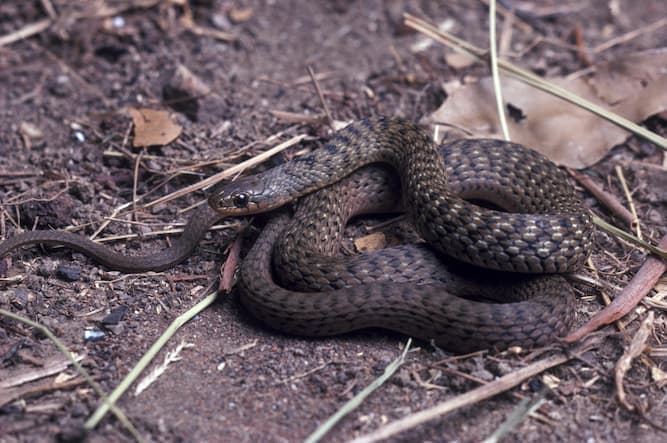
How to Identify a Keelback Snake
The keelback is a small to medium-sized snake with several distinctive features that can aid identification:
- Colour: Olive-brown to grey-brown with irregular darker bands or blotches along the body. Colouration can vary considerably between individuals.
- Scales: Keeled (ridged) scales give the skin a rough, textured appearance rather than the smooth, glossy look of many other species. This is the feature that gives the snake its common name.
- Size: Typically 0.5 to 0.8 metres in length. Rarely exceeds one metre, making it noticeably smaller than many other common Brisbane species.
- Build: Relatively stout body for its length, with a rounded cross-section.
- Head: Rounded head shape, not strongly distinct from the neck. Round pupils.
- Nuchal band: A pale band or marking behind the head (on the nape of the neck). This is one of the most useful identification features and is absent in the rough-scaled snake.
If you are unsure about a snake's identity, you can use our snake identification tool for guidance, but always treat any unidentified snake as potentially dangerous.
Keelback vs Rough-Scaled Snake: Critical Differences
This is the most important comparison for anyone encountering a keeled-scale snake in Brisbane North. The rough-scaled snake is one of Australia's most dangerously venomous species and has caused fatalities. Getting this identification wrong can have serious consequences.
Keelback (Non-Venomous)
- Rounder, less angular head shape
- Distinctive pale nuchal band behind the head
- Smaller size, typically under one metre
- Generally calmer temperament; less likely to strike
- Round pupils
- Completely harmless to humans and pets
Rough-Scaled Snake (Highly Venomous)
- More angular, defined head shape
- No nuchal band
- Larger size, commonly exceeding one metre
- More aggressive and defensive temperament
- Can be difficult to distinguish from keelback at a glance
- Highly venomous with potentially fatal bite
The bottom line: Both species have keeled scales and can appear similar in colour and pattern. If you cannot positively identify the snake, always treat it as venomous and call for emergency snake removal. The risk of misidentification is simply too high to take chances. As we discuss in our article on common snake myths, attempting to identify snakes without professional training is one of the most common mistakes people make.
Habitat and Behaviour
Keelbacks are strongly associated with water. You will almost always find them near creeks, dams, drainage lines, wetlands, garden ponds, and other moist environments. They are excellent swimmers and spend much of their time hunting in and around water.
They are primarily nocturnal and crepuscular, meaning they are most active during the evening, night, and early morning hours. During the day, they shelter under rocks, logs, leaf litter, and garden debris near water sources.
Their diet consists primarily of frogs and tadpoles, which explains their close association with aquatic habitats. They are also known to eat small fish and occasionally lizards. Keelbacks are generally placid and slow-moving, and they rarely attempt to bite when handled by professionals. When threatened, they may flatten their body and raise their head in a defensive posture, but this is largely a bluff display.
The Cane Toad Connection
The keelback holds a unique and ecologically significant position among Australian snakes: it is the only native Australian snake known to be immune to the toxins produced by cane toads. All other native snake species that attempt to eat cane toads are killed by the toad's powerful bufotoxin, which has devastated predator populations since the cane toad's introduction in 1935.
Keelbacks can safely consume cane toads of various sizes, making them one of the very few natural biological controls on cane toad populations. This resistance is thought to have evolved because the keelback's ancestors in Asia co-evolved with related toad species that produce similar toxins. This ecological role makes the keelback a genuinely valuable species in areas where cane toads have become established, including much of Brisbane North.
For this reason, keelbacks should never be harmed. If you find one in your garden, it is actively contributing to pest control. A professional snake catcher can safely relocate a keelback if its presence is causing concern, but understanding its beneficial role may change how you feel about having one nearby.
Where Keelbacks Are Found in Brisbane North
Keelbacks are commonly found throughout Brisbane North wherever suitable aquatic habitat exists. Key areas include:
- Boondall: The Boondall Wetlands and surrounding areas provide ideal keelback habitat with extensive waterways, reed beds, and frog populations. This is one of the most reliable locations for keelback sightings in Brisbane North.
- Virginia: Low-lying areas near Kedron Brook and other creek systems support healthy keelback populations. Residential gardens backing onto creek corridors are common encounter spots.
- Clontarf: Coastal waterway areas and tidal creek systems attract keelbacks, particularly during the warmer months when frog activity peaks.
What To Do If You Find a Keelback
Even though keelbacks are harmless, the critical issue is the potential for confusion with the venomous rough-scaled snake. For this reason, we strongly recommend the following approach:
- Do not handle the snake. Even if you believe it is a keelback, misidentification is a real and dangerous possibility.
- Keep a safe distance and keep children and pets away from the area.
- Take a photo from a safe distance if possible. This can help a professional identify the species before arriving.
- Call a licensed snake catcher for positive identification and, if needed, safe relocation.
A professional snake catcher can quickly and definitively tell you whether you are dealing with a harmless keelback or a dangerous rough-scaled snake, giving you peace of mind and keeping your family safe.
Keelback Snake FAQ
Is a keelback snake dangerous?
No. Keelback snakes are completely harmless to humans and pets. They are non-venomous and generally docile. However, because they are frequently confused with the highly venomous rough-scaled snake, you should never attempt to handle or identify a keeled-scale snake yourself. Always call a licensed snake catcher for safe identification.
How do I tell a keelback from a rough-scaled snake?
The most reliable field differences are the keelback's pale nuchal band behind the head (absent in rough-scaled snakes), its rounder head shape, and its smaller size (typically under one metre). However, these differences can be subtle and difficult to assess from a safe distance. Both species share keeled scales and similar colouration. The safest approach is to never attempt identification yourself and to call a professional who can examine the snake closely and safely.
Do keelbacks really eat cane toads?
Yes. The keelback is the only native Australian snake that can safely consume cane toads. They possess a natural resistance to bufotoxin, the powerful poison that cane toads produce. This immunity evolved through their ancestral connection to Asian snake species that co-evolved with similar toads. This makes keelbacks ecologically valuable in controlling cane toad numbers.
Where do keelbacks live?
Keelbacks are almost always found near water. Creeks, dams, drainage lines, wetlands, and damp gardens are their preferred habitats. In Brisbane North, they are commonly encountered around the Boondall Wetlands, creek systems in Virginia, and waterway areas near Clontarf. If your property has a garden pond, water feature, or backs onto a creek, you are more likely to encounter a keelback, particularly during the warmer months.
Need a Snake Identified or Removed in Brisbane North?
Robert Watson is a licensed, experienced snake catcher servicing all of Brisbane North and surrounding suburbs. Whether you've found a keelback, a rough-scaled snake, or any other species on your property, professional identification and removal is always the safest option. We are available for snake identification and on-site callouts around the clock.