Carpet Python Brisbane: Identification & Removal Guide
Reviewed by Robert Watson, licensed wildlife handler · Last reviewed: 1 July 2026
Carpet pythons are non-venomous but protected native snakes that commonly enter Brisbane roof spaces, sheds, trees, aviaries, chicken coops and yards in search of warmth, birds, possums or rodents. A carpet python is not usually an emergency unless it is inside, near small pets, caught in netting, or difficult to isolate, but it should still be handled by a licensed professional. Large pythons can bite defensively and may injure pets or poultry if left in the wrong place. Robert Watson removes carpet pythons using calm, low-stress handling, checks the situation for likely food or shelter attractants, and relocates the snake lawfully. If a python is in your roof, living area, shed or pet enclosure, keep your distance and call 0401 164 492 for advice. Robert can also advise on reducing rodents and roof access points.
Official snake safety references
The carpet python (Morelia spilota) is Brisbane's most commonly encountered snake species. Found throughout the northern suburbs from Arana Hills to Strathpine, these impressive constrictors regularly turn up in roof spaces, garden sheds, chicken coops, and backyard trees. While carpet pythons are completely non-venomous and pose no serious threat to humans, they are fully protected under Queensland law. If you find one on your property, you must contact a licensed snake catcher in Brisbane North for safe and legal removal.
Carpet pythons play a valuable role in the local ecosystem by keeping rodent and possum populations in check. Understanding how to identify them and what to do when you encounter one can save you considerable stress and help protect this native species.
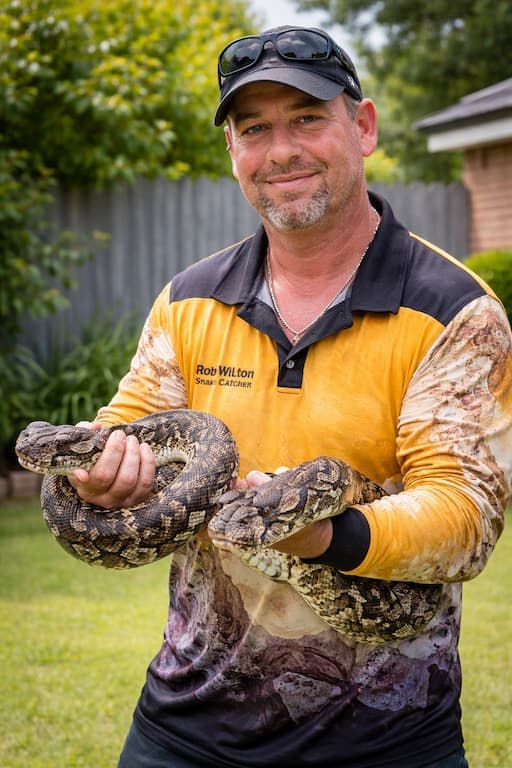
How to Identify a Carpet Python
Carpet pythons are one of the easier snake species to identify in the Brisbane region, though their colouring can vary considerably between individuals. Key identification features include:
- Colour and pattern: Olive, brown, or tan base colour with irregular cream, gold, or yellowish blotches running the length of the body. The pattern is highly variable and can appear bold or subtle depending on the individual.
- Body shape: Muscular, heavy-bodied build with a distinct head that is clearly wider than the neck. Their body feels solid and powerful when encountered.
- Size: Adults typically measure 2 to 3 metres in length, though specimens exceeding 3.5 metres are occasionally recorded in Brisbane. Hatchlings are around 30 to 40 centimetres long.
- Head features: Heat-sensing pits are visible along the lower jaw, which help the snake detect warm-blooded prey in complete darkness. Their pupils are vertical, typical of a nocturnal hunter.
- Scales: Smooth, glossy scales that often have an iridescent sheen in sunlight.
Carpet pythons should not be confused with venomous species such as the eastern brown snake, which has a much slimmer body, uniform colouring, and round pupils. If you are unsure about a snake's identity, use our snake identification tool or call us directly.
Habitat and Behaviour
Carpet pythons are semi-arboreal, meaning they spend a great deal of time in trees and elevated structures. They are equally comfortable on the ground and are powerful climbers, which explains their frequent appearance in roof cavities and ceiling spaces across Brisbane.
Where they shelter
- Roof spaces, ceiling cavities, and wall voids
- Garden sheds, garages, and storage areas
- Tree hollows and dense canopy vegetation
- Chicken coops, aviaries, and poultry enclosures
- Timber retaining walls and rock crevices
Hunting and diet
Carpet pythons are primarily nocturnal ambush predators. They position themselves along animal trails, on tree branches above nesting sites, or near entry points to buildings where rodents pass. Their diet consists mainly of possums, rats, mice, and birds. Larger individuals may occasionally take small domestic animals such as guinea pigs, rabbits, or poultry. They kill prey by constriction, coiling tightly around the animal until it suffocates, before swallowing it whole.
After a large meal, a carpet python may remain inactive for several days or even weeks while digesting.
Legal Status in Queensland
Carpet pythons are classified as protected wildlife under the Queensland Nature Conservation Act 1992. This means it is illegal to:
- Kill, injure, or harm a carpet python
- Capture or relocate one without a valid wildlife licence
- Keep a carpet python as a pet without the appropriate permit
Penalties for interfering with protected wildlife can be significant. The only lawful option when a carpet python is found on your property is to contact a licensed snake catcher who holds the correct permits for capture and relocation. Our carpet python removal service covers all of Brisbane North.
Where Carpet Pythons Are Found in Brisbane North
Carpet pythons are widespread across Brisbane's northern suburbs, but some areas see higher encounter rates than others due to habitat suitability:
- Arana Hills - leafy suburban properties with established tree cover provide ideal climbing and sheltering habitat. Carpet pythons are regularly found in roof spaces and garden trees throughout this suburb.
- Ferny Hills - homes adjacent to bushland reserves are particularly prone to carpet python visits. The combination of native vegetation and older-style roofing with accessible cavities makes this a frequent call-out location.
- Strathpine - older homes with unsealed roof cavities and properties keeping poultry are common encounter sites. Carpet pythons are drawn to these areas by the availability of food and shelter.
We also attend regular carpet python removals in surrounding suburbs. See our full Brisbane North service area for coverage details.
What to Do If You Find a Carpet Python
If you discover a carpet python on your property, remain calm and follow these steps:
- Do not attempt to handle or move it. Even though carpet pythons are non-venomous, they can deliver a painful bite with their backward-curving teeth when they feel threatened. Handling is also illegal without a licence.
- Keep children and pets away. Maintain a safe distance of at least a few metres and prevent dogs or cats from investigating the snake.
- Secure poultry and small pets. If you keep chickens, guinea pigs, or rabbits, ensure their enclosures are properly secured with fine mesh.
- Note the snake's location. Knowing exactly where the snake is helps us locate and remove it efficiently when we arrive.
- Call a licensed snake catcher. We provide prompt carpet python removal across Brisbane and can attend your property quickly.
For tips on reducing the likelihood of snake encounters around your home, read our guide on how to snake-proof your home.
Carpet Python FAQs
How big do carpet pythons get?
Most carpet pythons in Brisbane reach between 2 and 3 metres in length. Exceptionally large individuals can exceed 3.5 metres, though this is uncommon. Females are generally larger and heavier than males. Hatchlings emerge at around 30 to 40 centimetres and grow steadily over several years.
Will a carpet python eat my cat?
While a large carpet python is physically capable of taking a small cat or kitten, this is relatively rare. Their preferred prey includes possums, rats, and birds. The greatest risk is to very small kittens, poultry, and caged animals such as guinea pigs or rabbits. Keeping pets indoors overnight and securing enclosures with sturdy mesh significantly reduces the risk.
Can I remove a carpet python myself?
No. It is illegal to capture, relocate, or interfere with a carpet python in Queensland without a wildlife licence. Attempting to handle one also risks a painful bite and may cause the snake to become defensive and more difficult to capture. Always call a licensed snake catcher for removal.
How do carpet pythons get into roof spaces?
Carpet pythons are exceptional climbers. They access roofs by scaling brick walls, climbing downpipes, following overhanging tree branches, and squeezing through surprisingly small gaps in eaves, broken roof tiles, or uncapped vents. Once inside, a warm, undisturbed roof cavity with resident possums or rats is an ideal environment for them to stay long-term.
Need a Carpet Python Removed? Call Now
If you've found a carpet python in your roof, garden, or anywhere on your Brisbane North property, professional removal is the safest and only legal option. Robert Watson Snake Catcher is licensed, experienced, and available for prompt call-outs across Brisbane North.
For more information on our services and pricing, visit our snake removal cost page.